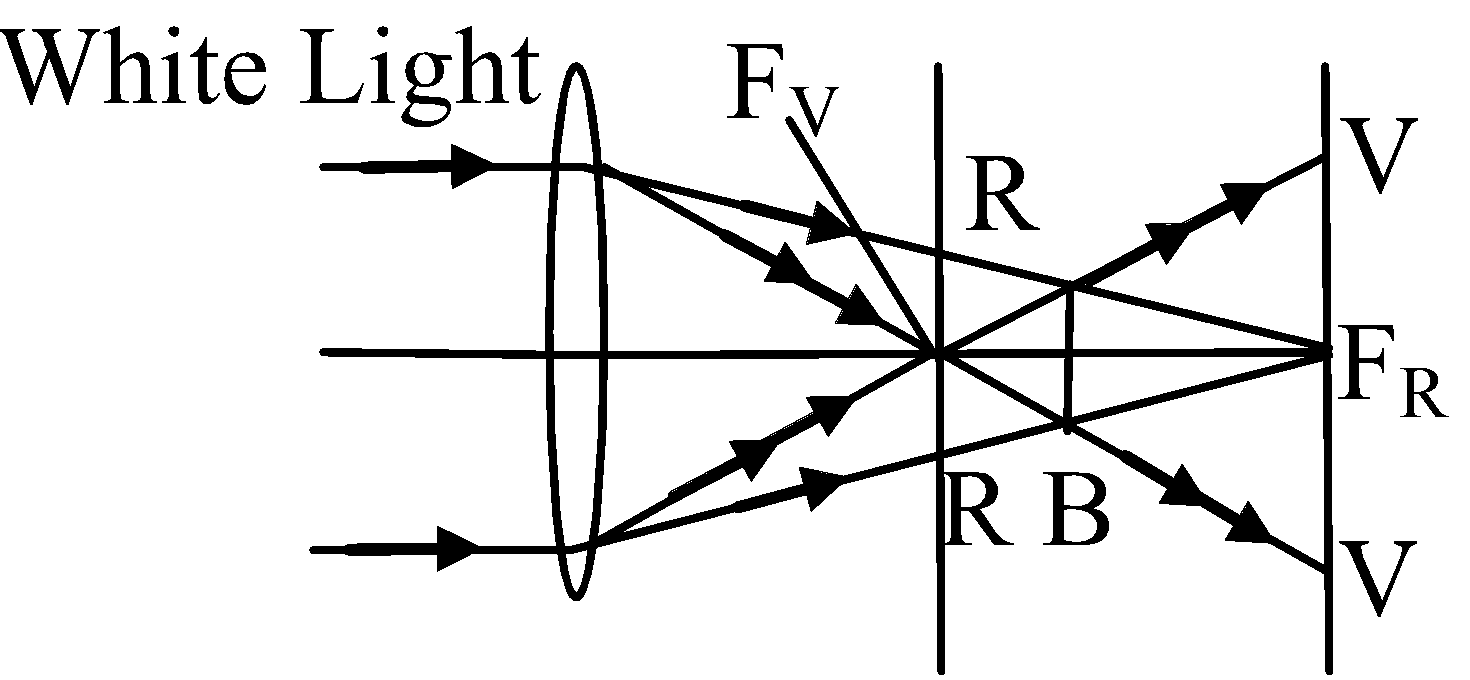
The image of a white object in white light formed by a lens is usually colored and blurred. This defect of image is called chromatic aberration and arises due to the fact that focal length of a lens is different for different colors. As µ of lens is maximum for violet while minimum for red, violet is focused nearest to the lens while red farthest from it as shown in figure.
As a result of this, in case of convergent lens if a screen is placed at F V centre of the image will be violet and focused while sides are red and blurred. While at F R , reverse is the case, i,e., centre will be red and focused while sides violet and blurred. The difference between f V and f R is a measure of the longitudinal chromatic aberration (L.C.A) , i.e.,
L.C.A.= f R – f V = – df with df = f V – f R .......(i)
However, as for a single lens,
 = (µ –1)
  ...........(ii)
⇒ –  = dµ
= dµ  ..........(iii)
Dividing Eqn. (3) by (2) ;
–  =
=  = ω
= ω
 = dispersive power ........(iv)
And hence, from Eqns. (i) and (iv)
L.C.A -= – df = ω f
Now, as for a single lens neither f nor ω can be zero, we cannot have a single lens free from chromatic
aberration.
Condition of Achromatism : In case of two thin lenses in contact
 =
=  +
+  i.e.
i.e.  =
=  –
– 
The combination will be from chromatic aberration if dF = 0
i.e.,  +
+  = 0
= 0
which with the help of Eqn. (4) reduces to
 +
+  = 0 i.e.,
  +
+  = 0 .....(v)
This condition is called condition of achromatism (for two thin lenses in contact) and the lens combination which satisfies this condition is called achromatic lens, From this condition. i.e., from Eqn. (5) it is clear that in case of achromatic doublet :
(1) Thw two lenses must be of different materials.
Since, if ω 1 = ω 2 ,  +
+  = 0
= 0
i.e.,  = 0 or F = ∞
i.e., combination will not behave as a lens, but as a
plane glass plate.
(2) As ω 1 and ω 2 are positive quantities, for Eqn. (5) to hold, f 1 and f 2 must be of opposite nature, i.e., if one of the lenses is converging the other must be diverging.
(3) if the achromatic combination is convergent,
f C < f D and as –  =
=  , ω C < ω D
i.e. in a convergent achromatic doublet. convex lens has lesser focal length and dispersive power than the
divergent one.
(i) Chromatic aberration in the formation of images by
a lens arises because:
Text Solution
Verified by ExpertsCHECK THE SOLUTION.
Ans.
(i)
Sol. From passage is correct.
(ii)
Sol. From points (2) and (3) of passage :
f and f' must be of opposite sign
Also ω C < ω D and f C < f D
which is satisfied only by .
(iii)
Sol.  +
+  = 0 ⇒
= 0 ⇒  = –
= –  =
=  .......(i)
⇒  =
=  +
+  =
=  ......(ii)
After solving (i) & (ii)
f 1 = 20 cm
f 2 = – 40 cm
Prepare Smarter with CGP Edu
Get practice questions, solutions, and test series in one place.
Write a Review
Share your experience with this question and solution.
Commentary
Send your comment, doubt, correction, or feedback to admin.
Similar Questions
Explore conceptually related problems